LONDON STATUES - SCIENCE AND ENGINEERING

Who has appeared in The Simpsons, Futurama, The Big Bang Theory, Star Trek and even on a Pink Floyd album? It's just one of many interesting things you'll discover below!
As usual, click on the names for Wikipedia entries.
Archimedes was a Greek mathematician, physicist, and engineer who's widely considered one of the greatest minds of ancient history. He made major contributions to geometry and engineering, including the principle of buoyancy (his "Eureka!" moment) and the design of innovative machines like the Archimedes' Screw.
Burlington House, Burlington Gardens
This is one of a series of learned figures on the façade at the rear of the Royal Academy of Arts on Piccadilly - rich pickings for this blogger with his telephoto lens. And I would recommend the café - especially if there's the queue for tables at Fortnum and Mason opposite - there usually is.
The Italian polymath dramatically improved the telescope and
made observations that supported the heliocentric model of the solar system.
For daring to suggest such a thing, Galileo spent the last nine years of his life under house arrest after being tried by the Roman Inquisition. Burlington House, Burlington Gardens
Galileo made some important discoveries outside astronomy, notably identifying that a pendulum's swing time is constant. His observations helped later clockmakers but he didn’t formalise
the law of the pendulum.
He went blind near the end of his life, yet continued to work and dictate scientific ideas, including theories on motion that later influenced Newton.
One of the most influential scientists in history, Newton
laid the foundations of classical physics. His laws of motion and universal gravitation, along with major work in optics and mathematics, shaped scientific thinking for centuries and dominated the understanding of the physical world until Einstein.
National Portrait Gallery City of London School, Blackfriars

 British Library Burlington House
 Tate Britain
The striking statue in front of the British Library is Eduardo Paolozzi’s bronze Isaac Newton, inspired by William Blake’s image of the mathematician mapping the universe.
Newton was a member of Parliament but only spoke once when he asked an usher to open a window. When he ran the Royal Mint, Newton made coins more difficult to forge and used scientific techniques to assess their gold and silver content. He also had forgers executed.
The
famous apple-falling story is a traditional anecdote rather than established
fact. It is generally believed that Newton was inspired to formulate his theory of gravitation* after watching an apple fall from a tree - but the bit about it falling on his head is almost certainly an embellishment.
* Newton's Theory of Gravitation: Every object attracts every other object with a force proportional to their masses and inversely proportional to the square of the distance between them.
The German mathematician, polymath and philosopher independently developed calculus at the same time as Isaac Newton. His mathematical notation (including the integral sign), proved more influential in the long term. He also worked on binary arithmetic, a fundamental concept in computer science. Leibniz has been called the last universal genius due to his vast expertise across many fields, which became a rarity with the coming of the Industrial Revolution and the spread of specialized labour.Burlington Gardens
Leibniz and Newton independently developed calculus and the dispute over who invented it first led to a bitter argument. Leibniz published first but The Royal Society accused him of plagiarism. Leibniz appealed to the Society to no avail - Newton was president at the time. Both are credited today. As well as his integral sign, Leibniz's dx/dy notation has also survived; Newton used dots (ẋ, ẏ).
The chemist and philosopher discovered oxygen (though
the discovery is shared historically with others). His experiments helped establish modern chemistry, while his political and religious views made him a radical figure of the Enlightenment. He was forced to flee from his Birmingham to London following violent protests at his support of the French Revolution. He spent his final years exiled in the newly independent United States - something else he supported.
30 Russell Square
The Institute of Chemistry was once based at 30 Russell Square (now part of UCL). Priestley also made significant contributions to the study of electricity - and invented soda water.
The French mathematician and astronomer refined Newtonian mechanics and worked on celestial mechanics and probability. Laplace figured out how planets stay in their orbits and how to calculate their precise positions. He predicted the existence of black holes over a century before Einstein.
Burlington House, Burlington Gardens
Napoleon made Laplace Minister of the Interior, a role he proved spectacularly bad at and held for just six weeks. When Napoleon asked why his book on celestial mechanics made no mention of God, Laplace supposedly replied: “I had no need of that hypothesis.” Laplace impressively managed to thrive under the monarchy, the French Revolution, the Directory, Napoleon, and the restored monarchy.
The Scot dramatically improved the steam engine, making it efficient enough for widespread use. His innovations powered factories, transport and mining, becoming a cornerstone of the Industrial Revolution. The unit of power is named after him.
Science Museum Foreign, Commonwealth and Development Office
Watt also coined the term 'horsepower'. He defined one horsepower as the equivalent of the energy expended by a single horse raising 33,000 pounds of water one foot in the air from the bottom of a 1,000 foot deep well in 60 seconds. So it's worth bearing that in mind when you're shopping around for your next Ferrari. If it's the £3 million F80, you're looking at 1,200 horsepower.
Rennie was a Scottish civil engineer who was active in the late 18th and early 19th centuries. He is best known for his work on bridges, canals, and docks. A meticulous planner and innovator, he incorporated cutting-edge technology in his projects. Rennie is considered one of the founding fathers of British civil engineering.
Rennie's designs were well ahead of his time – he helped create East London's docks and designed Southwark Bridge, Waterloo Bridge - and the London Bridge which was relocated to Arizona in 1971. Chainsaw magnate Robert Paxton McCulloch bought the bridge for £1.7 million and rebuilt it brick by brick in Lake Havasu City. The story that McCulloch thought he was buying Tower Bridge has always been denied. I actually stayed overnight in Lake Havasu City in 1986 when driving from the Grand Canyon to Los Angeles. At the time the town (hardly a city) was pretty dead; and everything looked rather tacky .....
.... but I now read that Lake Havasu City has become a huge tourist destination, attracting almost a million visitors a year (at least until recently). Perhaps it provides a handy stopover en route to LA from the Grand Canyon or Vegas. Or maybe they expect to see Tower Bridge.
The Cornish engineer's high-pressure steam engines enabled the first steam-powered locomotives. He also worked as a mining consultant.
Gower Street Science Museum
In 1808 Trevithick ran the first steam locomotive to carry passengers. People were invited to ride on the steam engine Catch Me Who Can around a circular track very close to the location of this commemorative plaque.
Marc Isambard Brunel was a French-born engineer who made significant contributions to British engineering, particularly in the development of tunnelling technology. He's probably best known for constructing the Thames Tunnel, the first tunnel under a navigable waterway. He also designed a machine that could mass-produce wooden blocks used in shipbuilding.
Science Museum
The Thames Tunnel remains in use today, carrying the Windrush Line between Wapping and Rotherhithe. Celebrating London’s diversity through railway lines is a worthy gesture, but it sits uneasily against the harsh reality faced by many post-war West Indian immigrants. Neither Marc Isambard Brunel nor his son Isambard Kingdom Brunel owned slaves and, by the standards of the day, treated their workers well. Given their astonishing engineering achievements, why was it not called the Brunel Line? Discuss.
Like his father before him, Brunel was an engineer extraordinaire and one of the defining figures of the Industrial Revolution. He designed game-changing bridges, railways and ships (including the SS Great Britain). As well as overseeing the completion of the Thames Tunnel, his creations included the Clifton Suspension Bridge, the Great Western Railway and Paddington Station. Brunel's work was marked by boldness, creativity, and a dash of controversy – he pushed boundaries and broke records. His legacy continues to inspire engineers and innovators today.
National Portrait Gallery Temple Place, Victoria Embankment
This famous photo of Isambard Kingdom Brunel has helped cement the modern image of the man. Brunel was only about 5 ft 4 in (1.63 m) tall. But before the launching chains of the Great Eastern in his iconic stovepipe hat, cigar in hand, he looks every inch the engineering genius.
Platform 8, Paddington Station
Science Museum
When launched in 1858, Brunel's SS Great Eastern was the largest ship ever built, the first iron ship of its scale, and the first to use both paddle wheels and a screw propeller. It was broken up in 1888-1889. But you can still visit his Great Britain in Bristol. Brunel's Clifton Suspension Bridge was only completed after his death.
Clifton Suspension Bridge and Brunel statue, Bristol
Widely known as the Father of Railways, George Stephenson had a pivotal role in developing the early railway system. Rising from a working-class background as a colliery engineman, he applied practical engineering skill to improve steam locomotives, most famously building Locomotion No. 1 for the Stockton and Darlington Railway (1825), the world’s first public railway to use steam locomotives. Stephenson standardised the railway gauge of 4 ft 8½ in, which is now used by around 60% of the world’s railways.
Science Museum National Railway Museum, York
Stephenson’s Rocket (above) became the most famous early steam locomotive after its decisive victory at the Rainhill Trials in 1829, a competition held to determine the motive power for the Liverpool and Manchester Railway. Designed by Robert Stephenson with crucial input from his father George, Rocket achieved speeds of around 30 mph - astonishing for the time - convincingly demonstrating that steam railways were fast, reliable, and economical enough for regular passenger services.
Pimlico Gardens
The opening of the Liverpool and Manchester Railway on 15 September 1830 was intended as a triumphant public showcase for the new age of steam. Among the dignitaries present was William Huskisson, a prominent MP. Tragically, Huskisson was struck by Rocket and later died from his injuries, becoming the first person to be killed by a passenger train. Stephenson used Rocket to rush Huskisson towards medical help, making it both the cause of the first railway fatality and one of the earliest emergency transport vehicles.
William Huskisson is remembered (in Roman toga) with this marble statue in Pimlico. The statue has been relocated several times before ending up in this relatively remote location. Why here? The reason is unknown; although the fact Huskisson was an advocate of slavery might be a clue.
A leading railway engineer and the son of George Stephenson, Robert Stephenson designed major bridges, tunnels and railways, helping to standardise rail transport across Britain. He died just a few days after the death of Isambard Kingdom Brunel, and is buried in Westminster Abbey next to Thomas Telford.
Euston Station (eventually) Science Museum
In recognition of Robert Stephenson's role as chief engineer on the construction of the London-Birmingham Railway, his statue has stood on the forecourt of Euston Station since 1871. But it is currently mothballed until HS2 is finished. The sculpture is the work of Baron Marochetti, also responsible for the Isambard Kingdom Brunel statue next to Temple Station. A statue of Robert's father also once stood at Euston. But it is now at the National Railway Museum in York.
Davy was a chemist who isolated chemical elements and also invented the Davy safety lamp, dramatically reducing mining. He mentored Michael Faraday, shaping the next generation of scientific discovery.
Burlington Gardens
National Portrait Gallery Royal Institution of Great Britain
Amongst the many scientific gems on display in the Royal Institution is the original Davy Lamp. Despite discovering the physiological effects of laughing gas (nitrous oxide), Davy was said to be a humourless man. Mary Shelley based Professor Waldman in Frankenstein on Davy. In the novel, Victor Frankenstein is inspired to discover the secret of life after attending a Waldman lecture.
A protégé of Humphrey Davy, Faraday was a self-taught scientist whose work whose work in electromagnetism paved the way for electric
motors and generators. The words ion, cathode and anode were his creation.
National Portrait Gallery Institute of Electrical Engineers, Savoy Place
In Faraday's hand is a coil which he used to create the first electro-magnetic spark. This statue is a copy of the one in the Royal Institution (below).
Faraday Museum, Royal Institution basement
The centrepiece of the museum - which is free to visit - is Michael Faraday's magnetic laboratory, displayed as it was in the 1850s .....
There is also an unusual memorial to Faraday on a roundabout at Elephant and Castle, where he lived as a child ....

The stainless steel structure was built in 1961 and contains (appropriately) an electrical substation for the Northern and Bakerloo tube lines. The intention was for it to be made of glass so the workings of the transformer were visible; but the possibility of vandalism prevented this. In 1996 it was awarded Grade II listed building status.
Lord Kelvin helped establish the foundations of thermodynamics. His work on heat, energy and electricity influenced everything from steam engines to telegraph cables. The kelvin temperature scale is named after him; it begins at absolute zero (minus 273.15 °C), the point where molecular motion theoretically stops. Although absolute zero can be approached, it cannot be reached.
Science Museum
In addition to his theoretical brilliance, Kelvin was deeply practical, holding over seventy patents. He was heavily involved in laying the first successful transatlantic telegraph cable, earning a fortune and a knighthood. He once declared that heavier-than-air flight was impossible - a reminder that even great scientists can be spectacularly wrong. So maybe 0°K can one day be achieved.
Bazalgette was the civil engineer behind London’s Victorian sewer system, which tackled cholera outbreaks and the Great Stink of 1858, his network dramatically improved public health and remains a vital part of London’s infrastructure.
National Portrait Gallery Northumberland Avenue
Flumini vincula posuit (he put the river in chains) is the Latin phrase beneath his bust on the banks of the Thames. To accommodate his sewer (and new tube tunnels) Bazalgette built The Victoria, Albert and Chelsea Embankments. This also had the advantage of making the Thames narrower and faster-flowing. He also had the foresight to make his tunnel, which opened in 1875, double the diameter required. This means Bazalgette's sewer has coped pretty well for 150 years, despite the population of London quadrupling. Only recently has an update been required, with the Thames Tideway Tunnel, also known as the "Super Sewer," officially opening in May 2025 - designed to last for at least 120 years.
Bazalgette never patented his designs, insisting they belonged to the public. He was obsessed with numbers and calculations; it is said he could compute complex estimates in his head faster than most could with pen and paper.
Greathead was a civil engineer best
known for developing the Greathead Shield, a travelling tunnelling device that made
deep-level tube railways possible. His work was crucial to the construction of
the City & South London Railway, the world’s first underground electric
railway, and underpins much of London’s modern Underground system. He was one of the first engineers to use compressed air in tunnelling to keep water and soil out - standard practice today, but risky and experimental at the time.
Cornhill/Royal Exchange
His statue at Cornhill/Royal Exchange conceals a ventilation shaft for the Central Line which opened in 1900. Tunnelling for the line had begun in 1996, shortly before Greathead died from stomach cancer, aged just fifty-two.
Greathead Shields are cylindrical which explains why deep-level London Underground tunnels are round rather than brick arches. At the time they were introduced, many doubted passengers would tolerate narrow, deep tunnels - Greathead’s engineering quietly proved them wrong.
Despite the Greathead Shield becoming standard worldwide, its inventor rarely sought public recognition, his creation being overshadowed by credit going to earlier inventors.
SAMUEL PLIMSOLL (1824–1898)
Plimsoll was a British politician who campaigned for maritime safety and introduced the Plimsoll Line, a mark on ships indicating safe loading levels. Sometimes clashing violently with shipping companies, his work saved countless sailors’ lives.


Plimsoll earned the nickname 'the sailors’ friend', though some shipowners called him 'the destroyer of commerce.' Ships were frequently overloaded, the owners having little regard to the safety of their crews - and knowing that any losses would be covered by insurance.
The Swedish naturalist created the modern system of biological classification. His method of naming species using binomial nomenclature (e.g. homo sapiens) remains the foundation of taxonomy today, bringing order to the rapidly expanding knowledge of the natural world and our understanding of biodiversity.
Burlington Gardens
For a time, as a joke, Linneus classified humans into groups using personality traits as well as ethnicity. He was known, appropriately in Latin, as Princeps Botanicorum - The Prince of Botanists.
Inevitably, he received some criticism for proposing humans were related to apes. And, more recently, there have been claims his taxonomy implied that certain human "races" were superior to others.
Darwin revolutionised biology with his theory of evolution by natural selection - 'the survival of the fittest'. Based on decades of observation, his book On the Origin of Species fundamentally changed our understanding of life on Earth and humanity’s place within nature. He delayed publishing his theory for twenty years due to the controversy he knew it would cause - it still does in some places.
Natural History Museum
Darwin was terrified of public speaking and rarely gave lectures. He almost didn't sail on HMS Beagle because the ship's captain thought his nose shape suggested a lack of character. He was the grandson of pottery manufacturer Josiah Wedgewood.
Baird was a was a Scottish engineer who pioneered television technology, demonstrating the first working television system and
making the world’s first public demonstration of television to members of the Royal Institution. He also made the first transatlantic TV transmission. The BBC used his system until 1937. After his pioneering technology was superseded, Baird made important progress in the development of colour television.
National Portrait Gallery
Whilst we have John Logie Baird to thank for the first ever TV transmission, there wasn't much on that day - just a ventriloquist's dummy called Stooky Bill. Early television required very hot lights - no problem for Stooky Bill, although his presentation was rather wooden. Later, Baird did successfully transmit a real person's face - an office boy named William Edward Taynton who was paid half a crown and endured the heat.
Scott was a naturalist, artist, conservationist and broadcaster who co-founded the World Wide Fund for Nature (WWF). His work helped bring environmental science and wildlife conservation into the public consciousness. Peter Scott was the son of explorer Robert Falcon Scott who perished in 1912 attempting to lead the first team to reach the South Pole. He also has a statue in London which will feature in my 'work in progress' of explorer statues.Barnes Wetlands Centre
In Britain, Peter Scott founded the Wildfowl and Wetlands Trust. The trust now owns or manages ten reserves in Britain, including the one at Barnes ....
The German-born physicist transformed physics with his theories of relativity, redefining concepts of space, time and gravity. His work underpins much of modern science and technology, from cosmology to GPS systems. His famous equation E=mc² had a profound impact on physics and beyond.
Tate Britain
On his 72nd birthday, Einstein stuck out his tongue for a photographer - a snapshot he liked so much he kept copies. It became one of the most iconic images of the twentieth century. Jacob Epstein made this bronze of Einstein in 1933 when he was staying in a refugee camp after fleeing Germany for Britain. A few months later Einstein left Britain for the USA to take up a post at Princeton University.
Young Albert didn't speak fluently until about age four or five - his parents worried he might have a development problem. In 1952 he declined the offer of the largely symbolic role of President of Israel.
Some Einstein quotes:
- “I have no special talent. I am only passionately curious.”
-
“A person who never made a mistake never tried anything new.”
-
“Science without religion is lame, religion without science is blind.”
- “The world will not be destroyed by those who do evil, but by those who watch them without doing anything.”
“I made one great mistake in my life - when I signed the letter to President Roosevelt recommending that atom bombs be made.” (referring to the 1939 Einstein–Szilárd letter)
-
“The problem involved in producing the atomic bomb was not technical; the problem was moral.”
The English physicist who produced ground-breaking theories on black holes and cosmology. Despite his diagnosis with motor neuron disease, he wrote bestsellers like A Brief History of Time and inspired millions. He lived to the age of 76, not bad for someone who, at 21, was given two years to live.
There are a few public statues of Stephen Hawking around the world but none in the UK. One was commissioned for the University of Cambridge, but the project wasn't completed due to the death of its funder. His ashes are interred in Westminster Abbey, with a memorial stone near the graves of Newton and Darwin.
Westminster Abbey
The stone bears the words "Here lies what was mortal of Stephen Hawking" and the formula 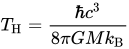 which determines the Hawking temperature of a black hole of mass. Yes, dear readers, I'm sure you're now saying to yourselves - "why didn't I think of that; it's so obvious".
 In popular culture, Hawking appeared as himself in Star Trek, The Simpsons, Futurama and The Big Bang Theory. In 1993, his synthesised voice was recorded saying "It doesn't have to be like this. All we need to do is keep talking" for Pink Floyd's Keep Talking on their Division Bell album. In the biographical film The Theory of Everything (2014) Stephen Hawking was portrayed by Eddie Redmayne.
The only legitimate child of poet Lord Byron, Ada Lovelace is widely regarded as the world’s
first computer programmer, writing the first algorithm intended to be processed by a machine. That machine was the Difference Engine, invented by her friend and mentor Charles Babbage.

 National Portrait Gallery 7 Millbank
The punched cards remind me of my college days in the 1960s where we learned Fortran. There was only the one computer at Liverpool University. It was huge and you had to book it to run your painstakingly prepared cards. It would usually grind to a halt well before reading all of them.
The computer language Ada, used by the US Department of Defense (or War, according to Trump), is named after Lovelace.
Babbage's difference engine was designed to print mathematical tables that would be much more accurate than the hand-written versions used by Victorian engineers and scientists. But it was not built in his lifetime. Instead, it was constructed in the 1980s by the Science Museum from Babbage's 1847-1849 designs ....


Difference Engine, Science Museum
The museum ensured that the difference engine's 4000 components were manufactured to the engineering standards of Baggage's day. It made its first error-free calculation in 1991, two hundred years after the birth of its inventor. The engine can complete a complex calculation with every fourth turn of the handle on the side. The results - up to 31 digits long - can be printed on paper.
Alan Turing was a mathematician and computer scientist whose theoretical work laid the foundations of modern computing. During the Second World War he played a crucial role in cracking German Enigma codes, shortening the conflict, yet he was later persecuted for his homosexuality.
National Portrait Gallery St Mary’s Square, Paddington
The tragic story of the brilliant WW2 codebreaker is well known especially by those who've seen The Imitation Game (2014) in which he was portrayed by Benedict Cumberbatch. He is generally considered to be the father of modern computing science.
Sir Tim Berners-Lee invented the World Wide Web. While working at CERN, he created the systems of URLs, HTTP and HTML that made the internet accessible to the public, revolutionizing global communication and information sharing, including amusing videos of cats.
National Portrait Gallery Sheen Lane Centre, Sheen Lane
The sculpture of Berners-Lee, by Sean Henry, is cast in bronze and painted. He is carrying the indispensable leather rucksack in which he keeps his laptop. The plaque is near where he was born and raised in East Sheen. His parents, both scientists, worked on the Ferranti Mark 1, the first commercially built computer.
"I want the web to reflect our hopes and fulfil our dreams, rather than magnify our fears and deepen our divisions" Tim Berners-Lee, 2018
When Berners-Lee appeared during the 2012 London Olympics opening ceremony an NBC commentator reputedly said: "If you haven't heard of him, we haven't either. But you can Google him!".
Thanks to Tim Berners-Lee, booking a great Airbnb condo in Malaysia is just a click away:
🏡 Visiting Ipoh? Relax in Comfort in the City Centre
If you’re coming to Ipoh - whether to visit family, explore the city, or travel for work - this family-friendly Airbnb apartment in the city centre offers a comfortable and practical place to stay.
Ipoh is well known for its street food and restaurants, where people happily travel for good meals at sensible prices. The apartment is well located for exploring popular places to eat, then returning somewhere quiet and comfortable - without paying resort or hotel prices.
👨👩👧👦 Well suited to families
🏊♂️ One of the best swimming pools in Ipoh, with a separate kids’ pool
🛏️ Clean, comfortable apartment with space to relax
❄️ Air-conditioning & fast, reliable Wi-Fi
🚗 Convenient for getting around
📍 City-centre location ideal for family visits and easy access to everything
💼 Business-friendly
Quiet weekdays ideal for work or remote meetings
Fast Wi-Fi makes staying productive easy
Comfortable, private environment — work without the hotel hassle
A straightforward, good-value base — perfect for both family visits and weekday business stays.
👉 View photos, reviews & availability on Airbnb CLICK HERE.
(APOLOGIES FOR THE AMBUSH MARKETING)
NEW: Click on Index for links to all my earlier posts.


 British Library Burlington House


 National Portrait Gallery 7 Millbank


very interesting, especially as i'd never heard of laplace or greathead.
ReplyDelete