Never painted a confirmed self-portrait - most “Leonardos” are educated guesses.
Wrote many notes in mirror-script (possibly to keep ideas private).
Designed flying machines centuries before aviation.
Left a surprising number of works unfinished. The Mona Lisa is valued at around $860 million to $1.5 billion. The Last Supper is considered priceless and can't be sold on the art market. Da Vinci's Salvator Mundi sold for $450 million in 2017, making it the most expensive painting ever sold at auction. Belgrave Square
Homage to Leonardo, The Vitruvian Man is by Enzo Plazzotta. Following Pazzotta's death in 1981, it was completed by Mark Holloway.
There have been accusations of 'unacceptable censorship' towards Italian broadcaster RAI for removing Vitruvian Man's genitals for their 2026 Winter Olympics titles sequence.
The sculptor who scandalised London
Self Portrait, National Portrait Gallery
His early public works were denounced as obscene.
Was attacked by crowds over his Oscar Wilde Memorial.
Society portraitist with a secret love
of landscapes
Frieze of Parnassus Self portrait, National Portrait Gallery
Most famous works: The Blue Boy; Mr and Mrs Andrews; The Morning Walk

 Mr and Mrs Andrews Mr and Mrs William Hallett
 (The Morning Walk)
National Gallery
Preferred painting trees to aristocrats - but portraits paid better.
Famous for fluid brushwork that looks effortless and isn’t.
Rivalry with Joshua Reynolds.
The cartoonist who invented social satire
Chiswick High Street Frieze of Parnassus
Hogarth (and his dog Trump) lived in Chiswick for many years; and is buried there. This statue was unveiled by Ian Hislop and David Hockney in 2001.
National Portrait Gallery Self Portrait withTrump, NPG
National Portrait Gallery
Trump appeared in many of Hogarth's paintings. Mocked everyone: aristocrats, clergy, and artists themselves.
Invented the modern comic strip in painted form.
Championed artists’ copyright laws.
The face-maker of the Tudor court
National Portrait Gallery Frieze of Parnassus
Most famous works: The Ambassadors; Portrait of Henry VIII; Christina of Denmark
Henry VIII - National Portrait Gallery
The Ambassadors Christina of Denmark
National Gallery
Court painter to Henry VIII. Essentially defined how Henry is remembered. His portraits are so precise they feel forensic.
No reliable portrait of Holbein himself survives.
Augustus John (1878–1961)
Bohemian painter, legendary womaniser
National Portrait Gallery
Bust (1916) by Jacob Epstein, photo (1902) by George Charles Beresford
The Mumpers - Detroit Institute of Arts
Famous almost as much for his lifestyle as his art.
He fathered at least eighteen children, by five different women.
Painted with swagger - loose lines, big personalities.
Titan of the High Renaissance
Frieze of Parnassus, Albert Memorial
Michelangelo is uniquely featured twice on the Parnassus Frieze — among artists (left) and sculptors (right).
Considered himself a sculptor above all else.
Painted the Sistine Chapel ceiling lying on his back.
Famously grumpy, solitary, and obsessive.
Full name Michelangelo di Lodovico Buonarroti
Pre-Raphaelite prodigy and rebel turned establishment figure
John Islip Street (rear of Tate Britain) National Portrait GalleryThe portrait (1871) is by George Frederic Watts
Co-founded the Pre-Raphaelite Brotherhood at just 19.
Later became a very successful society painter.
Died as President of the Royal Academy. His portrait of a Victorian boy became Bubbles on Pear's soap ....
Designer,
poet, socialist - enemy of ugly things.
Bexleyheath Clock Tower William Morris Museum, Walthamstow
National Portrait Gallery
The portrait (c. 1880s) is by William Blake Richmond. There are no self-portraits of William Morris painted as he wasn't very good at faces and would often leave them for his friend Rossetti to fill in.
WilliamMorris Museum, Walthamstow House next door
Most famous works: Strawberry Thief; Trellis; Kelmscott Chaucer (book design)
Strawberry Thief (textile design) Trellis (1862) his first wallpaper
Kelmscott Chaucer (extract)
Arts and Crafts visionary, poet, novelist and political activist.
Despised industrial mass production.
Designed wallpaper which is still sold today.
In 1891 he founded the Kelmscott Press to publish limited-edition books.
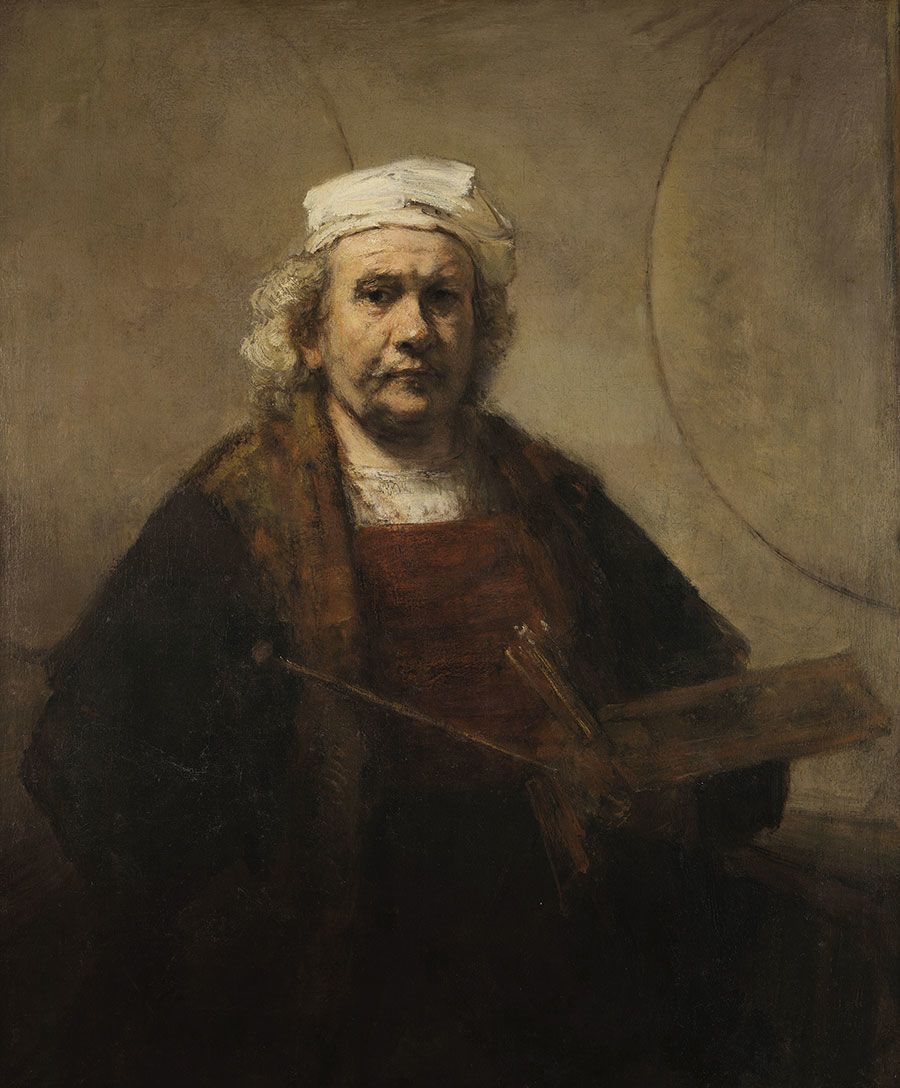
The greatest self-portraitist in art history
Frieze of Parnassus
Self Portrait (1640, age 34) Self Portrait (1669, age 63)
National Gallery
Painted himself repeatedly over four decades, around 80 works altogether.
Died in relative poverty.
Revolutionised the use of chiaroscuro (light and shadow).
Self-Portrait with Two Circles can be seen at Kenwood
Full name Rembrandt Harmenszoon van Rijn.
The theorist of British painting
Royal Academy
The sculpture is by Alfred Drury who was commissioned after winning a competition in 1917. But Drury was so busy sculpting memorials after WWI, the statue of Reynolds was not completed until 1931.
Burlington House Frieze of Parnassus
National Portrait Gallery Foreign, Commonwealth and Development Office
Portrait of Dr Samuel Johnson Lady Sarah Bunbury Sacrificing to the Graces
National Portrait Gallery Art Institute Chicago
First President of the Royal Academy which he founded with Gainsborough.
Believed artists should study the Old Masters relentlessly.
Promoted the “Grand Style” in portraiture.
Painted almost everyone important in Georgian Britain.
Dante Gabriel Rossetti (1828–1882)
Poet, painter, and Pre-Raphaelite
romantic
Chelsea Embankment Gardens
This bust is outside Rossetti's house at 16 Cheyne Walk. The original was stolen some years ago and this is a fibre glass copy.
Self portrait Plaster cast of death mask
National Portrait Gallery
Obsessed with medieval themes.
Key influence on Symbolism.
Exhumed his wife’s grave to retrieve poems he’d buried with her.
The colourist of the Venetian Renaissance

Frieze of Parnassus
Most famous works: Venus of Urbino; Assumption of the Virgin; Bacchus and Ariadne
Bacchus and Ariadne - National Gallery Painted for emperors and popes.
His loose brushwork influenced later masters like Rubens.
Repainted and revised works years after “finishing” them.
Lived into his late 80s or 90s - exceptional for the time.
Tiziano Vecellio was his birth name.
Painter of light, weather, and chaos


Tate Britain National Portrait Gallery (by John Linnell)
Frieze of Parnassus There is a large collection of Turner's works at Tate Britain - but not The Fighting Temeraire which is in the National Gallery.
The Fighting Temeraire Rain, Steam and Speed
National Gallery
His late works verged on abstraction, baffling contemporaries but inspiring modernism.
Left thousands of sketches alongside finished paintings.
Bequeathed much of his estate to fund artists.
His full name is Joseph Mallord William Turner.
Anthony van Dyck (1599–1641)
Flemish portraitist of English royalty


National Portrait Gallery
Most famous works: Charles I at the Hunt; Charles I in Three Positions; Self-Portrait (above)
Charles I in Three Positions - Royal Collection
Court painter to Charles I, shaping the image of royalty in the 17th century. Defined aristocratic portrait style for centuries.
Facial hairstyle named after Van Dyck (see Leon Trotsky, Colonel Sanders, Johnny Depp).
Venetian school painter of splendour, scale and spectacle
Frieze of Parnassus
The frieze numbers 167 men, one woman and two dogs - Hogarth's Trump and the greyhound with Veronese. Whilst Trump existed, there is no evidence of Veronese owning a dog. So the inclusion of the greyhound, an aristocratic dog associated with royal courts, is likely symbolic.
The Rape of Europa - National Gallery
The Venetian Holy Inquisition were not happy with the "irreverent detail" in Veronese's painting of The Last Supper of the Christ. So, following his interrogation, he re-titled his work Feast in the House of Levi.
Art for art’s sake
Whistler's Reach, near Battersea Bridge
Arrangement in Grey and Black No.1 is better known as Whistler’s Mother. And, yes, it actually is his mother who came off the subs bench when Whistler's Model failed to turn up. The artist's intention was for his subject to be standing - but his mother was having none of that.
Famously sued John Ruskin for libel - and won - but only received a farthing in damages.
Gave musical titles to paintings.
American who lived much of his life in Europe.Antony Gormley (born 1950)
The sculptor who uses his own body
National Portrait Gallery River Thames, Limehouse
Wellcome Collection. Euston
Most famous works: Angel of the North; Another Place; Event Horizon
Turner Prize winner.
Most of his works are casts of himself.
Event Horizon consists of 31 castings of Gormley's body which have been displayed around the world, including New York and Rio de Janeiro.
Angel of the North, Gateshead
One of Britain's largest statues; and also one of the most-viewed pieces of art in the world, see by around 90,000 people per day. This is because it is visible from both the Great North Road ( A1) and main line railway. Another Place, Crosby Beach, near Liverpool
The installation consists of one hundred castings of Gormley's nude body.


#/media/File:%22The_Last_Supper%22_by_Leonardo_da_Vinci_-_Joy_of_Museums.jpg)

Why Epstein scandalous? Who are Mumpers? William WALLACE museum in Walthamstow?!!
ReplyDeleteThank you to my former sub editor (who I replaced with AI) for (smugly) spotting the Wallace/Morris error. The testicles on Epstein's flying creature were deemed offensive by the Paris authorities and covered up. After a long standoff Epstein agreed to a fig leaf being added. Mumpers are beggars.
ReplyDelete